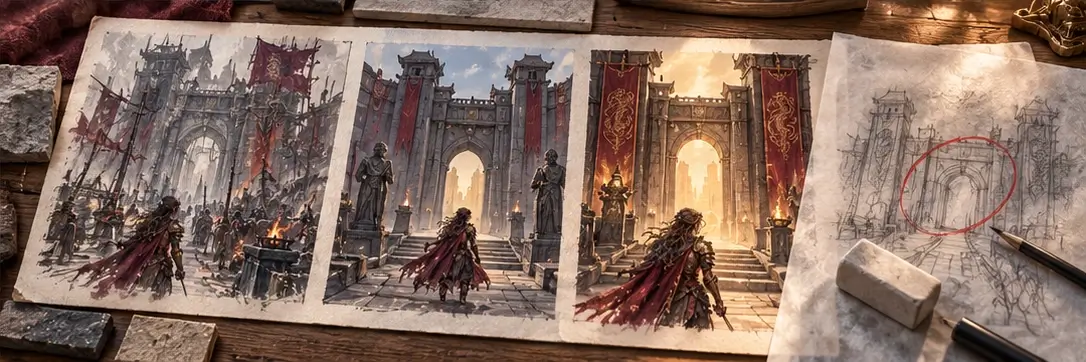
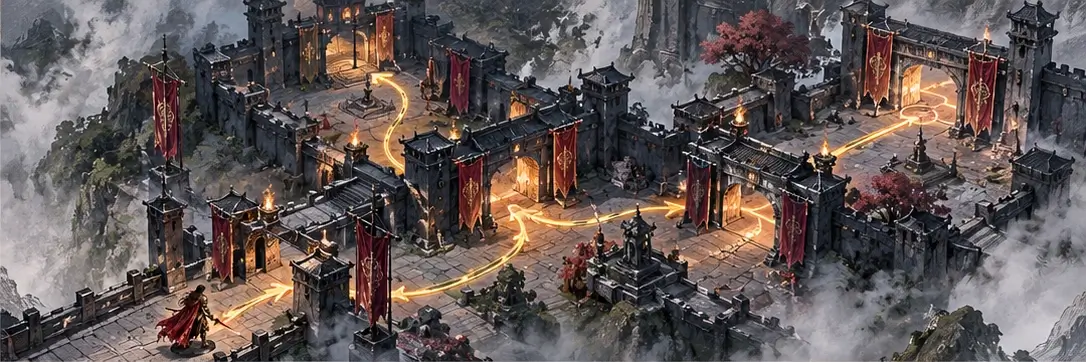
Start with a destination
A route is a sequence of decisions, rather than a line drawn across a level. Before adding branches, decide what the player is trying to reach and what they should notice along the way. A distant tower can give a forest path direction; a warm doorway can promise shelter after a difficult climb. Keep that destination visible often enough to maintain confidence, but let the foreground change the immediate problem. The player needs a reason to continue, and a useful question to answer before the next bend.
Make the junction speak
At a junction, the environment should explain the difference between choices. A narrow ledge suggests precision, a broad bridge suggests exposure, and a sheltered passage suggests observation. Those signals do not need to reveal every reward. They should let someone make an informed choice without opening a map after every few steps. Place the strongest landmark beyond the junction, where it can confirm the route once the player commits. If both branches look equally urgent and equally anonymous, extra signposting will rarely solve the underlying problem.
Give shortcuts a memory
A satisfying shortcut reconnects places the player already understands. Imagine a gate first seen from the wrong side of a ravine. Reaching its latch later changes the meaning of that earlier view and makes the landscape feel coherent. The reward is not simply a shorter walk. It is evidence that the world has relationships worth remembering. Avoid treating every shortcut as a hidden prize; some should become obvious as soon as a player learns a new movement skill or recognises the right landmark.
Test the return journey
Walk the route backwards before considering it finished. A dramatic arrival can become a confusing departure when important shapes disappear behind walls or lighting changes their contrast. The return journey also reveals unnecessary repetition: a room that offers a meaningful challenge once may become an irritating toll on every visit. Keep a few recognisable anchors, provide a convenient connection where appropriate, and allow the player to feel that familiarity has changed their options. A world becomes more generous when knowledge genuinely helps someone move through it.
Leave space for interpretation
A clear route can still support curiosity. Small detours, optional overlooks and environmental clues invite players to form their own reading of a place. The distinction is between uncertainty about what might be discovered and uncertainty about whether movement is working at all. Protect the second kind of clarity while making room for the first. During review, ask testers where they thought each branch would lead and why. Their explanations reveal whether the route communicates through the world or merely relies on repeated correction.
Explore Shadow & Ember