The lantern sees only so far
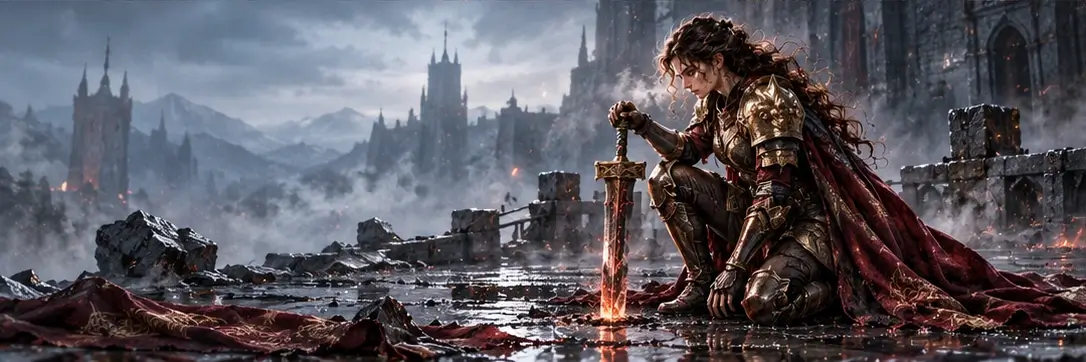
The knight's ember lantern makes a modest circle in the ruined sanctuary. Beyond it, a pale opening interrupts the wall. That opening can invite movement without becoming an arrow. The proposal works because local light and distant light do different jobs: one lets the player inspect the ground, the other offers a possibility. If the lantern reaches every corner, the invitation becomes unnecessary. If it reveals too little, the player cannot choose a safe step. Navigation begins with that relationship between what is knowable now and what seems worth approaching.
Build a chain of decisions
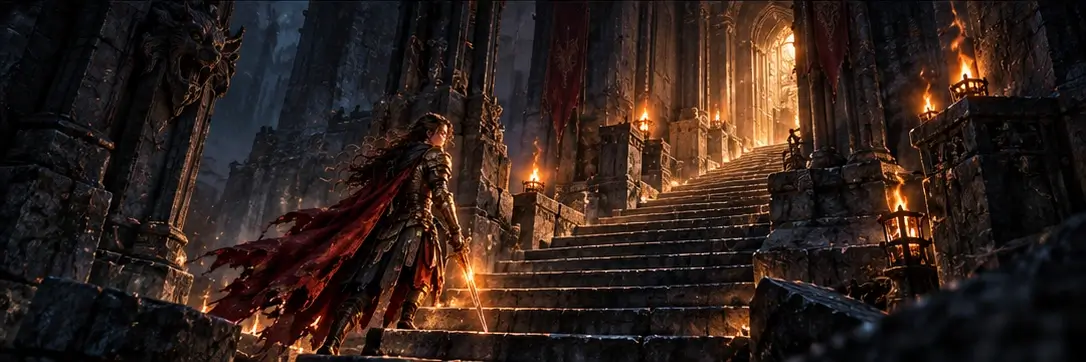
A bright destination at the end of a long passage does not explain how to reach it. Give the approach intermediate evidence: light catching a stair edge, a reflection beneath an arch, a shadow interrupted by a doorway. Each cue should become useful at the point where a choice occurs. The sequence can bend and pause instead of forming a continuous illuminated stripe. In Shadow & Ember, a broken roof might supply the first cue and a maintained brazier the next. Different sources can share a navigational function while preserving the place's history.
Darkness needs something to hide
There should be room to look away from the brightest path. A darker side chamber could contain a keeper's abandoned tools, while the main route carries the knight towards a guardian. Make the side chamber readable enough to recognise as an opening. Absolute darkness is not a subtle invitation; it may simply look like the edge of the playable space. The light hierarchy should express likelihood and importance, not forbid curiosity. Essential hazards need clearer evidence than optional discoveries, because missing a cup and missing a broken stair have different consequences.
Restoration changes the return
Relighting a beacon can alter a familiar route without moving its walls. A previously uncertain arch gains depth; a stair becomes recognisable from the courtyard; the glow reaches a neighbouring refuge. Preserve stable landmarks while changing these relationships, so the player feels the effect of restoration rather than becoming lost in a newly graded scene. The lantern can still reveal smaller details along the return. The beacon should not replace every local decision with complete visibility, especially if exploration depends on noticing what lies just outside the obvious path.
Ask for a destination, not a compliment
To examine the route, show a proposed junction without its objective marker and ask where someone would go and why. Then compare that reading under lower brightness, fog and a different viewing angle. A cue that works only in a carefully chosen screenshot has a narrow useful life. Light can guide discovery, but it cannot reliably communicate every instruction across all displays and vision needs. Keep optional map guidance available for necessary destinations. The aim is a convincing invitation whose meaning survives ordinary play, with support when the invitation is missed.
Explore Shadow & Ember