The shield is a sentence
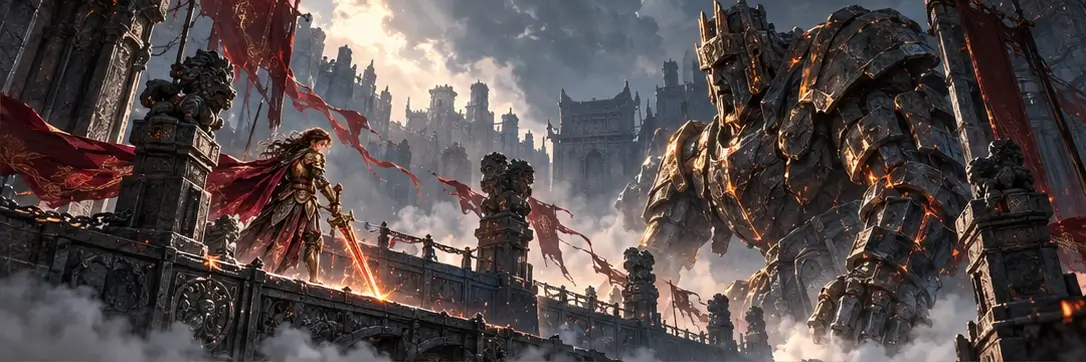
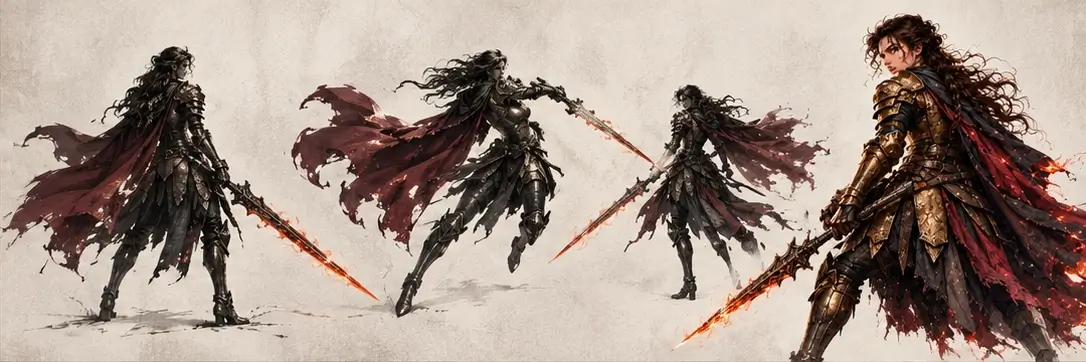
Imagine the brown-haired knight standing beneath a broken arch in Shadow & Ember. Her shield moves across her chest; a guardian lowers its head on the far side of the courtyard. Even with the textures removed, those two shapes should suggest different intentions. The knight is bracing. The guardian is gathering itself. This is where a silhouette becomes useful: it lets a player begin reading an encounter before identifying every piece of equipment. A handsome outline that says nothing about the next action has solved only half the problem.
Keep air between the forms
The tempting revision is often another piece of armour. A wider shoulder plate looks stronger in a portrait, but it can fill the opening between the shield and the knight's face. That little wedge of air may be doing more work than the plate. Try moving the elbow, turning the shield or reducing the shoulder before adding a glow. Her loose brown hair can supply a recognisable asymmetry, provided it does not overlap the weapon hand. Character identity and action clarity need room to coexist.
One body, several distances
A pose is not equally readable everywhere. Close to the camera, the angle of a wrist can explain a defensive gesture. At the usual encounter distance, the same gesture may need a clearer turn through the shoulders. Far away, only the distribution of mass remains. A useful concept pass therefore places the knight at several likely screen sizes, rather than choosing one flattering view. Avoid exaggerating everything to serve the smallest image; quiet sanctuary conversations would inherit a theatrical body language they do not need.
The crowded courtyard
A clean black cutout is a starting point, not a verdict. Put the guardian behind a pillar, let an ally cross the knight's path and leave some rubble near her feet. Now ask which part of the pose still carries its meaning. If the feet disappear, the torso may have to communicate the weight shift. If the weapon disappears, the free arm may need to establish direction. Some overlaps are inevitable. The aim is to preserve the decisive clue through ordinary movement, without making every character occupy an empty stage.
Ornament can come back
Once the important poses read, decoration has a better brief. A ragged cloak can emphasise a retreat; the ember lantern can mark the knight's centre when her shield turns sideways. Compare short, unlabelled clips and ask viewers what action they expect next. Wrong answers are more useful than compliments, because they identify the ambiguity. This approach suits combat intentions and quick recognition. It should not become a rule that every emotional beat must announce itself from across the room. Sometimes uncertainty belongs to the character; uncertainty about a charging guardian rarely does.
Explore Shadow & Ember